



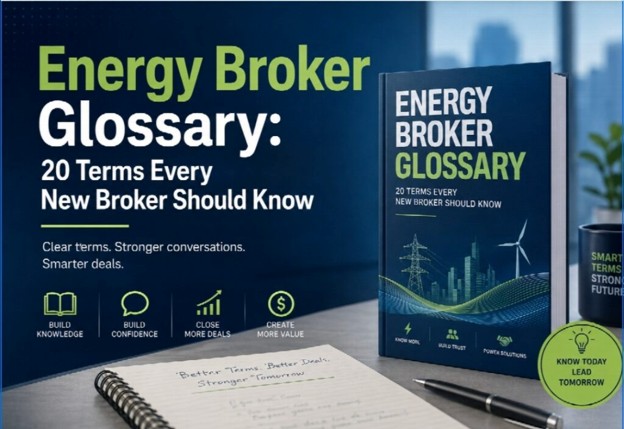
Walking into the energy brokerage world for the first time can feel like everyone’s speaking a different language. Uplift, load profile, POR, PUR, index rate… it’s a lot to take in, and if you don’t know the lingo, it’s tough to sound credible in front of a client. Whether you’re new to being acommercial energy broker or just brushing up, here’s a plain-English rundown of the terms you’ll run into the most.
The Money Terms
Commission is pretty straightforward, it’s what the supplier pays you for bringing them a customer. Usually calculated per unit of energy the customer uses over the life of the contract.
Uplift is a bit different. Instead of a flat commission, uplift is a small markup added directly onto the customer’s rate, and that markup is your cut. It’s baked right into the price the customer sees, rather than being a separate payment from the supplier.
Margin just refers to the overall spread between what the supplier charges and what the customer pays, whether that’s coming from commission, uplift, or both. A good energy broker solution will track all of this automatically so you’re not doing the math by hand every time a deal closes.
The Rate Terms
Fixed rate means the price per unit stays the same for the whole length of the contract, no surprises. Index rate (sometimes called variable rate) moves with the wholesale market, so it can go up or down month to month. Some customers love the predictability of fixed, others are willing to gamble on index if they think prices are heading down.
Wholesale price is what suppliers pay to buy energy on the open market, before any markup gets added. Retail price is what the end customer actually pays, after the supplier and broker have both taken their cut.
The Contract Terms
Load profile is basically a snapshot of how much energy a customer uses and when, hour by hour, day by day. Suppliers use it to price a contract accurately, since a business that uses a ton of power during peak hours costs more to serve than one that spreads its usage out evenly.
POR (Purchase of Receivables) means the utility buys the customer’s bill from the supplier and handles the billing and collections itself. PUR (Provider of Utility Rate) is a similar setup but the details can vary by state, it’s worth double-checking how it works in your market.
Evergreen clause is a sneaky one to watch for, it’s a contract term that automatically renews the agreement unless the customer cancels within a specific window. Good to know so you can flag it for clients (or use it to your advantage, depending on which side of a renewal you’re on).
The Market Terms
Deregulated market is any state or territory where businesses can choose their own energy supplier instead of being stuck with the default utility. Regulated market is the opposite, no choice, no broker opportunity.
RTO/ISO stands for Regional Transmission Organization or Independent System Operator, basically the organizations that manage the regional power grid and wholesale market (think ERCOT in Texas or PJM covering a big chunk of the East Coast and Midwest).
Capacity charge is a fee tied to a region’s peak demand, meant to make sure there’s enough power generation available when everyone needs it most.
Why Knowing This Stuff Actually Matters
Clients can tell pretty fast whether a broker actually knows their stuff or is just reading off a script. Getting comfortable with these terms means you can answer questions on the spot, build trust faster, and close deals without stumbling over the basics.
And once you’ve got the vocabulary down, a good energy broker platform makes it a whole lot easier to put that knowledge to work, pulling load profiles, comparing fixed vs. index offers, and tracking commission or uplift. Backing it with solid energy broker software means none of that math has to happen by hand.
